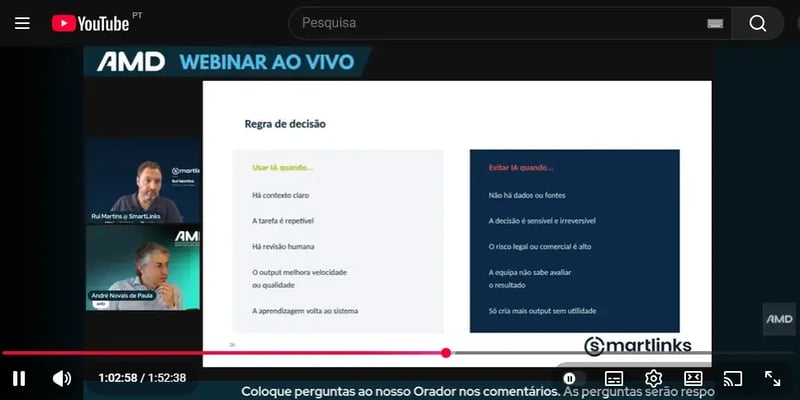
More than just choosing the right tools, the adoption of artificial intelligence in companies depends on processes, structured knowledge, high-quality data, and clear criteria.
This was the main message conveyed by Rui Martins, CEO and co-founder of SmartLinks, during the webinar “AI in Business: Why Tools Don’t Solve the Problem, but Systems Do,” hosted by AMD—the Association of Direct and Digital Marketing—and presented by André Novais de Paula on July 30.
Watch the full webinar on AMD’s YouTube channel.
Drawing on SmartLinks’ real-world experience, Rui Martins shared the mistakes, lessons learned, and changes that made it possible to transform isolated AI experiments into systems that are useful for the company.
Here are the seven key takeaways.
1. The problem is rarely the tool
How many companies have purchased an artificial intelligence tool that they end up not using?
We had a similar experience here, when an attempt to automate tasks took six months but never made it to production.
The project began in a controlled manner. A data specialist was hired, three reports were selected for a pilot project, and a reduced cost per report was established. If the test proved successful, the solution would be rolled out gradually.
On paper, all the conditions were in place for it to work.
Six months later, none of the prototypes were of sufficient quality to be presented to a client.
The problem wasn’t necessarily the technology or the consultant’s technical expertise. What was missing was context, organized information, analysis criteria, and a well-defined process.
Without this foundation, AI can process information, but it does not understand the business, the objectives, or what distinguishes a good response from a generic one.
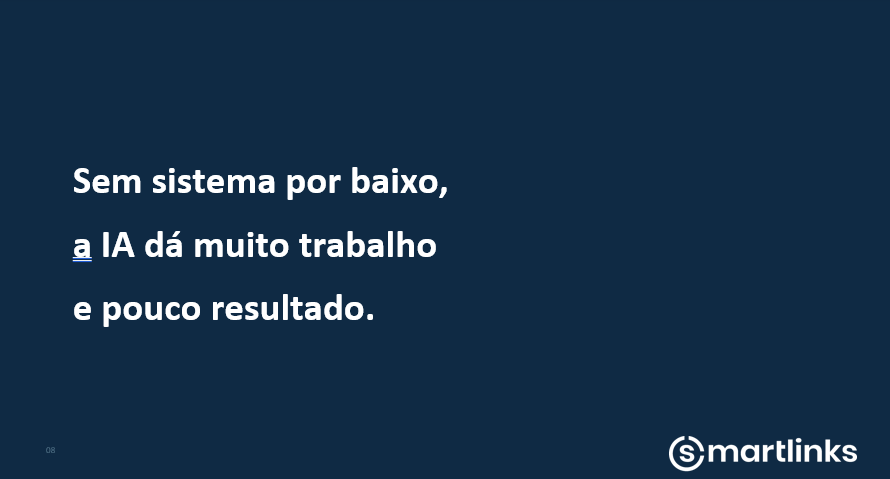
The main lesson is simple: without an underlying system, AI requires a lot of work and yields few results.
2. A company should start with the problem, not with AI

The most common question remains: What is the best AI tool?
And the answer is: it depends on the task.
AI should only be introduced after the company understands:
- what problem it wants to solve;
- how the process currently works;
- what information is available;
- who will evaluate the results;
- and how the impact will be measured.
SmartLinks uses different AI solutions because each tool may offer distinct advantages depending on the objective, the process, and the type of result sought.
Before testing or purchasing a new solution, a company should ask:
- Where can AI really be useful to us?
- Where are we just using AI so we can say we use AI?
Before choosing a solution, a company must understand where AI can create real value and where it’s merely being used because it’s trendy.
3. Most companies buy in the wrong order
Most companies start by buying a tool and then try to adapt it to their processes.
The order should be the other way around:
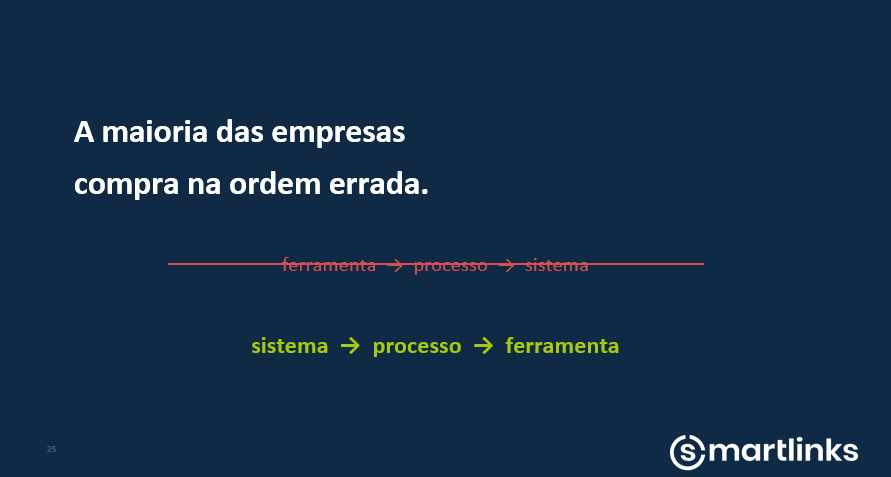
First, the principles, rules, responsibilities, and decision-making criteria must be defined. Then, the process is structured.
Platforms such as Salesforce, Microsoft, or HubSpot can offer very advanced capabilities. However, no technology alone can solve the problems of a poorly defined process, scattered knowledge, or criteria that exist only in the minds of a few people.
The most important question, therefore, is not “Which tool should we buy?” but rather:
- Do we already have a system where AI can be integrated?
4. AI needs context and structured knowledge
An AI tool without context tends to produce generic responses, even when it has access to real data.
To overcome this limitation, SmartLinks began organizing information into three broad areas.
Structured knowledge
This includes the company’s offerings, positioning, internal processes, quality criteria, decision-making protocols, and how the company solves problems.
Real-time information
This includes data in the CRM, sales interactions, customer signals, and the current status of opportunities.
Performance data
Includes metrics, results, trends, and quantitative information about campaigns, projects, and operations.
With this foundation, AI can interpret data, organize information, identify patterns, propose actions, and speed up tasks.
Before this change, much of SmartLinks’ knowledge was concentrated in the most experienced members of the team. Each new conversation with an AI tool started practically from scratch.
It was necessary to explain all over again who the company was, what services it provided, how it evaluated a project, and what distinguished a good result from an unsatisfactory one.
To address this limitation, SmartLinks began centralizing its internal knowledge in Markdown files hosted on GitHub. This model allows the company to organize, update, and make information available to various AI systems.
The approach is similar to the OKF— Open Knowledge Format, an open format designed to structure knowledge for use in different artificial intelligence systems.
Its evolution also introduces confidence indicators, which make it possible to indicate:
5. AI amplifies what already exists
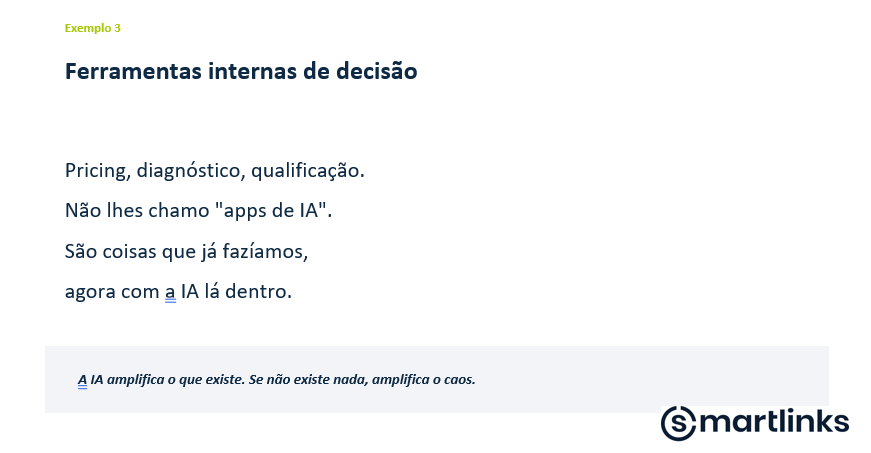
This was one of the most widely shared ideas during the session.
When a company has good processes, clear criteria, and structured information, AI can increase speed, consistency, and execution capabilities.
When that foundation is lacking, the technology tends to exacerbate problems already present in the organization.
It can generate more useless content, reports without analysis, responses without context, or more information that no one knows how to use.
A good example is the sales qualification of the leads we receive.
When faced with a potentially fake quote request, the system can cross-reference various indicators, such as:
Thus, a fake lead is disqualified within seconds after the system identifies various risk indicators. The decision and the reasons behind it are logged in the CRM for later validation by the sales team.
Once again, it’s all about context. The AI was able to support the decision because it was familiar with the company’s ICP and qualification protocols.
6. Adopting AI requires new roles and critical thinking
Not everyone needs to be an expert in artificial intelligence.
However, it is important to define who:
- sets the quality criteria;
- turns useful experiences into processes;
- uses the systems in daily work;
- develops the technical integrations.
As AI takes on a larger share of the work, critical thinking becomes even more important.
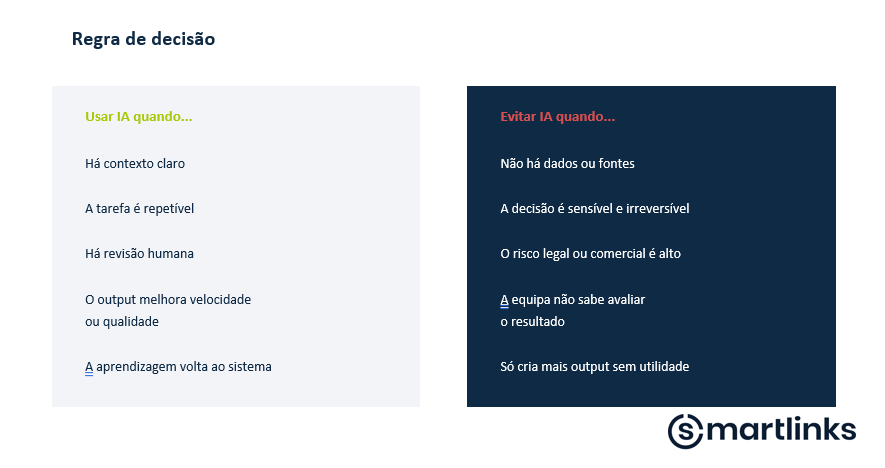
7. The final decision must remain in the hands of the people
The use of AI should be based on a model of co-intelligence.
Technology can speed up analysis, organize information, identify patterns, and suggest courses of action. Humans retain the responsibility for assessing nuances, interpreting context, and making the final decision.
This distinction becomes particularly important when making decisions:
SmartLinks does not provide sensitive personal data to AI tools. The information used consists primarily of internal knowledge about processes, business data, and anonymized information.
In addition, reports, proposals, content, and decisions are always reviewed by the appropriate person.
AI should support human thinking, not replace it.
A diagnosis to start with
For companies looking to evaluate or reorganize their use of AI, the webinar raised some practical questions.
Where are we using AI?
It is necessary to map out all existing uses, including those that employees already engage in on their own initiative.
The tools, costs, purposes, responsible parties, and results must be identified.
Do any of these uses produce measurable results?
If it is not possible to measure the impact, there probably isn't a true use case yet.
There is only experimentation.
What is missing from uses that do not produce results?
In most cases, the answer isn’t another tool.
What’s missing is context, a defined process, structured data, quality criteria, or someone responsible for validation.
From productivity to better decision-making
Artificial Intelligence can free up time for higher-value tasks.
For Rui Martins, increased efficiency has created more room to think. For example, improving sales skills, developing new products, exploring business opportunities, and devoting more attention to strategy.
The role of leadership is also changing. Instead of focusing time on execution, it is now possible to devote more attention to setting criteria and making decisions.
The central question raised by the webinar therefore remains particularly relevant:
Want to know how we can apply this to your company?