We've spent the last few years trying to make Artificial Intelligence smarter.
Larger and faster models.
With more context and better reasoning.
More tools with greater autonomy.
GPT. Claude. Gemini. And all the ones yet to come.
But I’m starting to think that, for companies, the problem no longer lies primarily there.
We already have plenty of intelligence available.
Probably far more than most organizations can actually put to use.
And the market signals are becoming very clear.
OpenAI says that what’s holding companies back is no longer the intelligence of the models themselves, but rather the way agents are built and operated within organizations. OpenAI
Deloitte found something similar: AI adoption is growing rapidly, but only 34% of organizations say they are actually reinventing their business around it.
And when it comes to autonomous agents, only about one in five companies says it has a mature governance model. Deloitte
And KPMG’s CEO Outlook, published in October 2026, highlights virtually the same issue from a different angle: only 9% of CEOs say that autonomous agents are already truly transforming their organizations, even though 39% already report significant improvements and another 43% report some impact in specific cases. KPMG
In other words:
technology is advancing faster than companies are able to adapt to it.
And this is where the next major phase of enterprise artificial intelligence begins.
It won’t just be a race for the best model.
It will be a race to see who can turn all this intelligence into real work, within a real organization, with real data, real processes, and real control.
That, to me, is what it means to start becoming AI Ready.
What does it mean for a company to be AI Ready?
Simply put:
An AI-Ready company is one that is prepared to integrate Artificial Intelligence into its work processes in a useful, contextualized, controlled, and measurable way.
It doesn’t mean having ChatGPT, Code, or Copilot.
It doesn’t mean having a handful of automation tools.
Nor does it mean replacing people with bots.
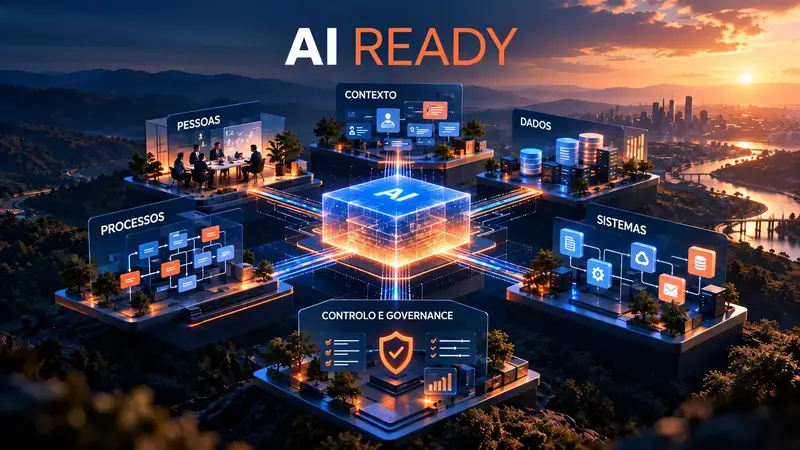
It means that the company has the data, context, processes, systems, rules, and responsibilities necessary for people and AI systems to work together.
This distinction will become increasingly important.
Because we’re moving from AI that responds to AI that also acts.
And that changes practically everything.
First, we gave AI to people
The first wave of generative AI in businesses was relatively simple.
A person would open a window.
They asked a question.
The model would respond.
It was essentially this: Person → Prompt → Model → Response
And this, in and of itself, created enormous gains.
Write faster.
Analyze information.
Prepare presentations.
Programming.
Summarize meetings.
Generate ideas.
Conduct research.
Produce content.
I use AI myself every day for several of these tasks.
And during this phase, it made perfect sense to ask: which model is best?
Because there were huge differences (and there still are).
But in the meantime, we started giving the models something new.
Tools.
Then we gave the models tools
A model was no longer limited to responding with text.
They could now search. Read files. Execute code.
To query a database. To access a CRM and send information to an application.
Call APIs, use MCP servers, and interact with many other tools.
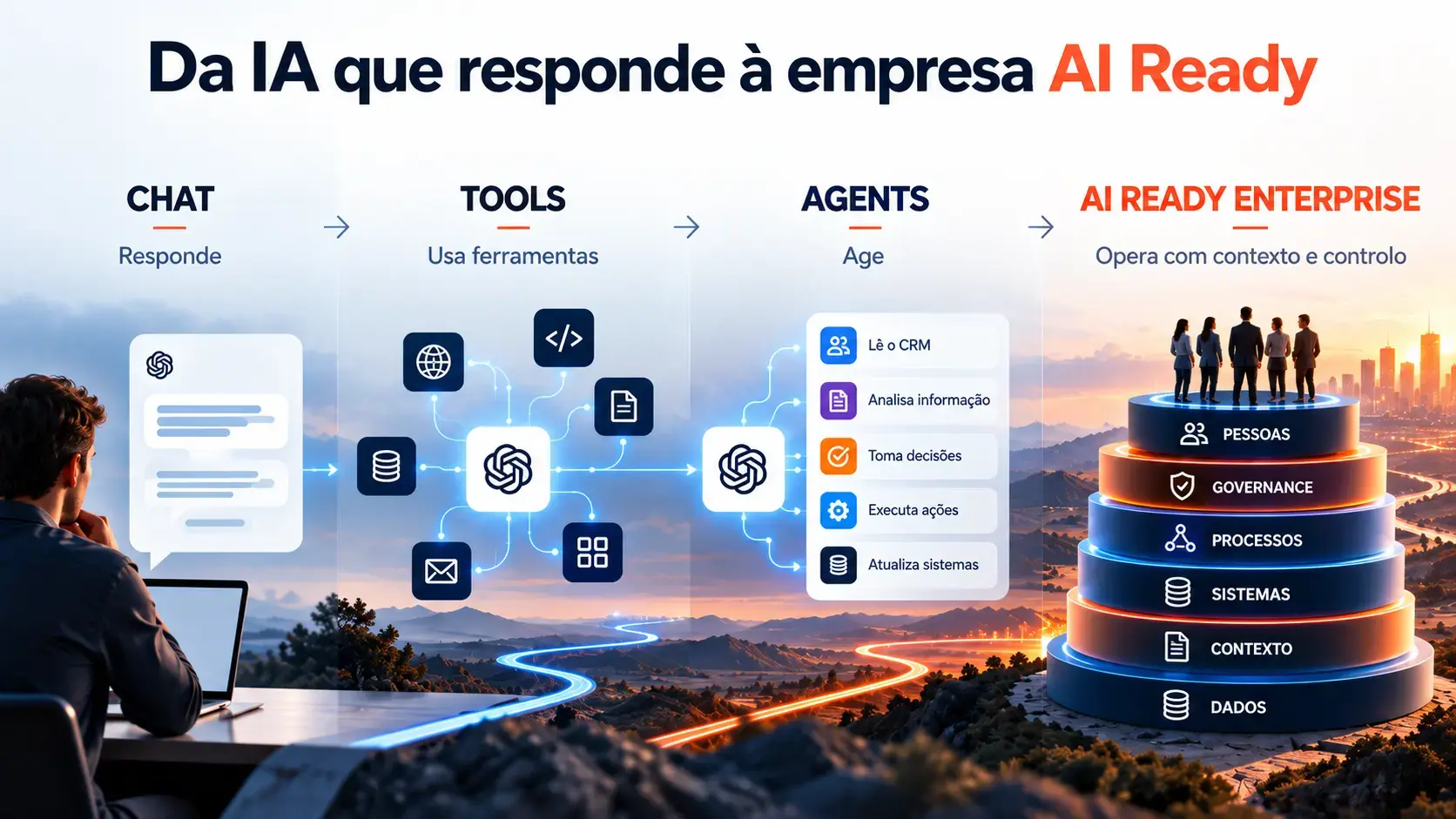
And this is where we truly begin to enter the era of AI Agents.
An agent can receive a goal, analyze the situation, use tools, observe the result, and continue working until the task is completed.
Microsoft, for example, has already structured its Agent Framework precisely around these components: agents, workflows, tools, context, memory, middleware, evaluation, and what it calls the Agent Harness. Microsoft Learn
And this is a huge change!
Before, we might have asked: Should I contact this customer?
Now a system can, potentially:
- view the client’s history;
- read the minutes of the last meeting;
- check the opportunity in the CRM;
- analyze the emails;
- determine what the next step should be;
- prepare a response;
- create a task;
- update the deal;
- and request approval from the sales representative before sending anything.
This is no longer just text generation. It’s work.
This is where Agent Harness comes in
I recently wrote about this concept on LinkedIn because I think “Agent Harness” will become an increasingly common term.
In that article, I used a simple metaphor: a horse.
The horse is the model. It has strength, speed, and power.
The rider is the person or the organization. They know where they want to go.
And the harness is what allows that power to be channeled and transformed into controlled movement.
Technically, it’s not much different:
Microsoft defines an Agent Harness as the runtime infrastructure that transforms a language model into an agent capable of performing work: it manages calls to the model and tools, state, context, approvals, and multi-step tasks. Microsoft Learn
Google describes it similarly: the software environment surrounding the model that allows it to interact with external tools, maintain state, and execute multi-step tasks. Google Cloud
But there’s one important thing to note here.
The harness doesn’t solve everything.
Because we can build a technically perfect agent...
...and it still won’t understand a thing about our company.
The model has knowledge, but the company has context.
I think this is one of the most important ideas behind this whole shift.
A model can know a lot (and it does). Much more than any single person. But it doesn’t necessarily know:
- who our customer is;
- what was agreed upon yesterday;
- what our ICP is;
- what proposal we sent;
- why we lost a particular deal;
- who can approve a discount;
- what is the minimum margin;
- who is responsible for that account;
- what is the internal process;
- what exception was approved;
- or why a particular customer shouldn’t receive a certain email.
This isn’t common knowledge.
That’s business context.
And it’s becoming an extremely valuable infrastructure.
It’s no coincidence that OpenAI has placed what it calls “Business Context” at the heart of its Frontier platform.
The idea is to connect agents to the systems where the company actually operates—CRM, data warehouses, and internal applications—so that AI can use the same information that people use and build institutional memory over time. OpenAI
This is a significant shift.
Because over the past few years, we’ve talked a lot about models that know more.
Now we’re starting to talk about:
how to make the model know more about us.
Data and context aren’t exactly the same thing
There’s a difference here that I think is important.
Let’s imagine these three levels.
Data: Deal value: 50,000 €.
Information: The €50,000 proposal was sent ten days ago.
Context: The CEO attended the last meeting. He’s comparing us to another supplier. The main concern isn’t price—it’s implementation. We agreed not to follow up before Friday.
Data, information, and context are very different.
An agent may have access to the first two levels and still make a terrible decision.
Because it’s the context that allows them to understand the meaning of that information at that moment.
And this helps explain why so many AI initiatives get stuck somewhere between an interesting pilot and a truly useful implementation.
Because it’s not enough to simply connect the model to the data.
The data must be:
- reliable;
- accessible;
- understandable;
- related;
- up-to-date;
- and sufficiently contextualized to support decision-making.
Deloitte identified a specific gap between organizations’ strategic ambition and their operational readiness: companies feel better prepared in terms of strategy than in terms of infrastructure, data, risk, and talent. Deloitte
It’s a much less glamorous problem than launching an agent.
But it’s probably much more important.
CRM now plays an even more important role
And this is where I start to look at CRM in a different light. For years, we’ve told companies: “Keep your CRM up to date.”
Because salespeople need the data.
Because we need reporting.
Because marketing needs segmentation.
Because we want forecasts.
All right. But now there’s another reason, and it might be even more important than all the previous ones:
CRM is becoming one of the main sources of context for Artificial Intelligence.
Think about what’s already in there.
- Contacts.
- Companies.
- Deals.
- Lifecycle stages.
- Emails.
- Calls.
- Meetings.
- Tickets.
- Activities.
- Properties.
- Owners.
- Associations between objects.
- History.
- Workflows.
All of this helps an AI system understand: who this person is, what happened before, and what should happen next.
And we see this trend very clearly at HubSpot.
In July 2026, HubSpot launched Agent Hub and Agent Builder specifically with the goal of managing and creating agents that share context and use the data already in the CRM. HubSpot
Data Agent already uses CRM data—calls, emails, deal history, documents, and external information—to research customers, populate properties, and power workflows. HubSpot Knowledge Base
And at Fall Spotlight in September 2026, HubSpot went even further, introducing concepts such as Growth Context, Context Home, and a CRM that updates itself more and more automatically. HubSpot
The direction seems quite clear to me:
The CRM is no longer just for storing information about people.
It’s also becoming a layer of context for agents.
And this significantly changes the importance of data quality.
For years, we could say: If the CRM is wrong, the report will be wrong.
Now we can add: If the CRM is wrong, AI may also act based on incorrect context.
It’s a completely different problem.
But a company’s context doesn’t all fit into a CRM
Nor should we go to the other extreme.
CRM isn’t everything, nor should it be.
A company has context in many places:
- ERP.
- Billing.
- Data warehouse.
- Support.
- Project management.
- Documents.
- Contracts.
- Product.
- Email.
- Teams or Slack.
- Knowledge bases.
- Proprietary applications.
- Operating systems.
That’s why one of the major changes we’re seeing is the creation of an increasingly robust layer of integration between AI and enterprise systems.
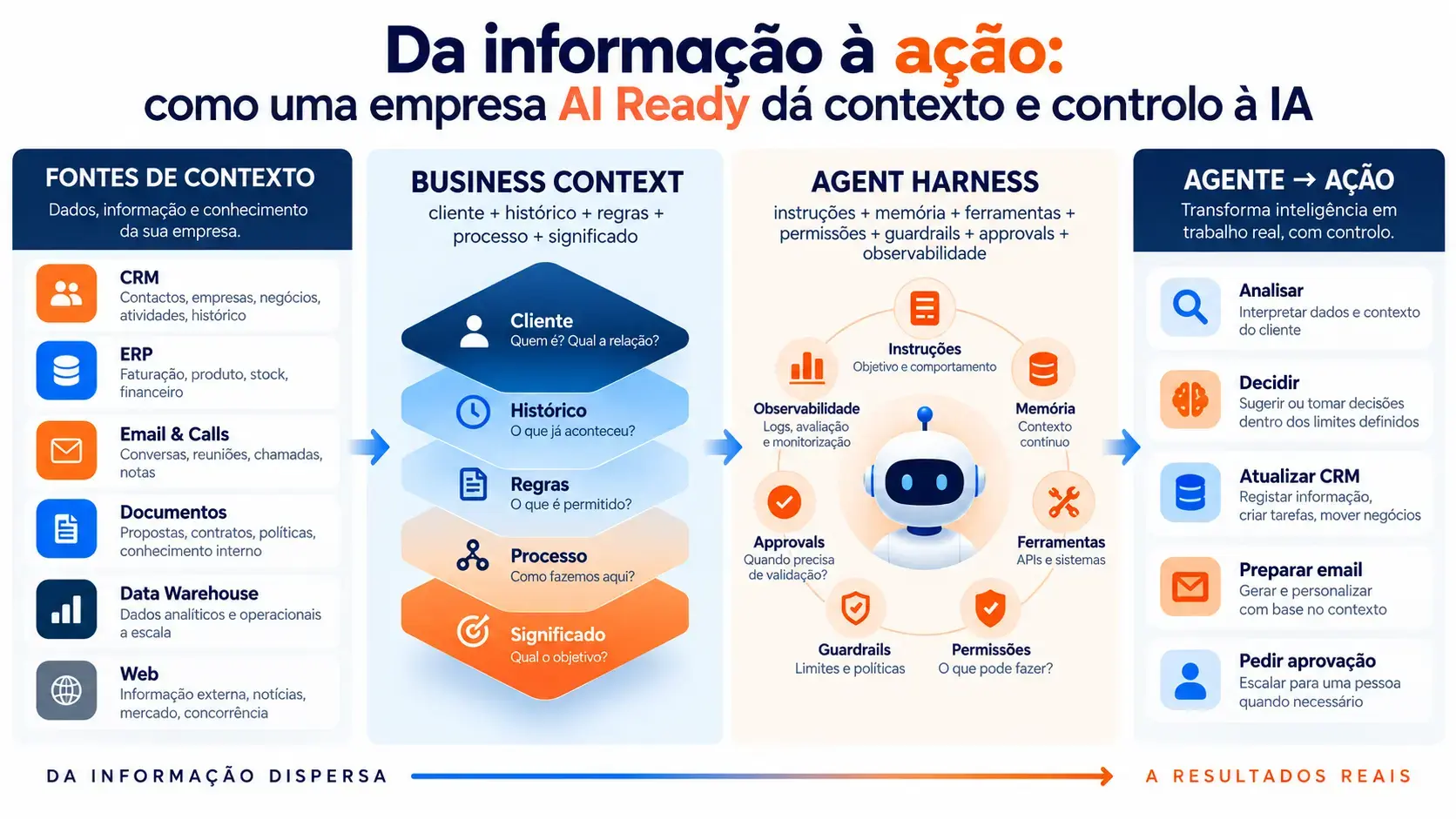
HubSpot itself, for example, enables two-way synchronization with Snowflake, Google BigQuery, and AWS S3 to bring together data residing in different parts of the stack. HubSpot
And the trend isn’t about “putting everything into the CRM.”
It’s something else entirely.
Ensuring that the right information reaches the right AI, at the right time, with the right permissions.
This will force many companies to rethink what they’ve treated as separate issues for years.
CRM | RevOps | Data | Integrations | Automation | Knowledge management | Governance.
Suddenly, all of this begins to converge, because it all feeds into the same thing: context.
The more autonomy we give to AI, the more control we need
There’s yet another important change.
When a model simply generates text, the risk is relatively contained.
It might even write something wrong, but we correct it.
Now imagine a system that can send an email, update a lead in the CRM, respond to a customer, create an order, manipulate data, initiate a workflow, execute code, or make a decision automatically.
The problem changes—and for the worse.
Because then we’re no longer just talking about intelligence—we’re talking about authority.
What can this agent do?
With what data?
To what extent?
When does he need approval?
Who is responsible?
How do we know what happened?
Can we audit it?
Can we stop it?
Can we correct it?
That’s why concepts like permissions, guardrails, approvals, observability, and human-in-the-loop are shifting from the technical realm to a management discussion.
Microsoft already includes tool approvals and observability directly in the Agent Harness architecture. Microsoft Learn
OpenAI explicitly incorporates permissions, auditing, and governance into Frontier’s enterprise architecture. OpenAI
And Deloitte has identified a very clear gap: nearly three-quarters of organizations plan to implement agentic AI in the next two years, but only 21% say they have a mature model for governing autonomous agents. Deloitte
There’s a phrase that sums this up well:
Autonomy without governance is not transformation. It is an automated risk.
Human-in-the-loop isn’t going away
I also don’t believe in the idea that the solution is a company where everything runs autonomously and humans just stand by and watch.
At least that’s not the path we’re interested in pursuing at SmartLinks.
“Human-in-the-loop” doesn’t mean a person clicking “approve” every three seconds.
That wouldn’t make sense either.
It means creating levels of autonomy. Because:
There are things an agent can do on its own.
There are things they can prepare but not execute.
There are things that require approval.
And there are things to which they simply should not have access.
And these levels of autonomy are exactly what we already do with people!
A junior sales rep can’t do exactly the same things as a sales director.
A marketing professional doesn’t necessarily have access to bank accounts.
Not everyone can approve a discount.
Not everyone can sign a contract.
Why should it be any different with an agent?
The challenge becomes building systems where autonomy increases as the following also increase:
trust;
observability;
data quality;
predictability;
and the ability to recover when something goes wrong.
Buying AI doesn’t make a company AI-ready
This is perhaps the mistake I see most often right now!
Buying ChatGPT, Copilot, Claude, or HubSpot for the entire company doesn’t make the company AI-ready.
Neither does creating three agents.
All of these can help, yes. But they’re just tools.
If, underneath them, we continue to have:
an outdated CRM;
scattered data;
processes that no one can explain;
teams working in silos;
contradictory information;
six versions of the same document;
poorly defined responsibilities;
and decisions that exist only in the minds of two or three people...
...AI isn’t going to magically fix the organization.
In some cases, it may simply accelerate the disorganization.
And that’s why I think the question is shifting.
For a while, it was: “How do we implement AI?”
Increasingly, it should be: “How do we prepare the company so that AI can work within it?”
This is a very different question.
The 7 Layers of an AI-Ready Company
I’ve been thinking of this as a set of seven layers.
They are not seven products, nor are they seven tools.
They are seven conditions that need to be in place—at different levels of maturity—so that we can move from AI experiments to systems that consistently deliver value.
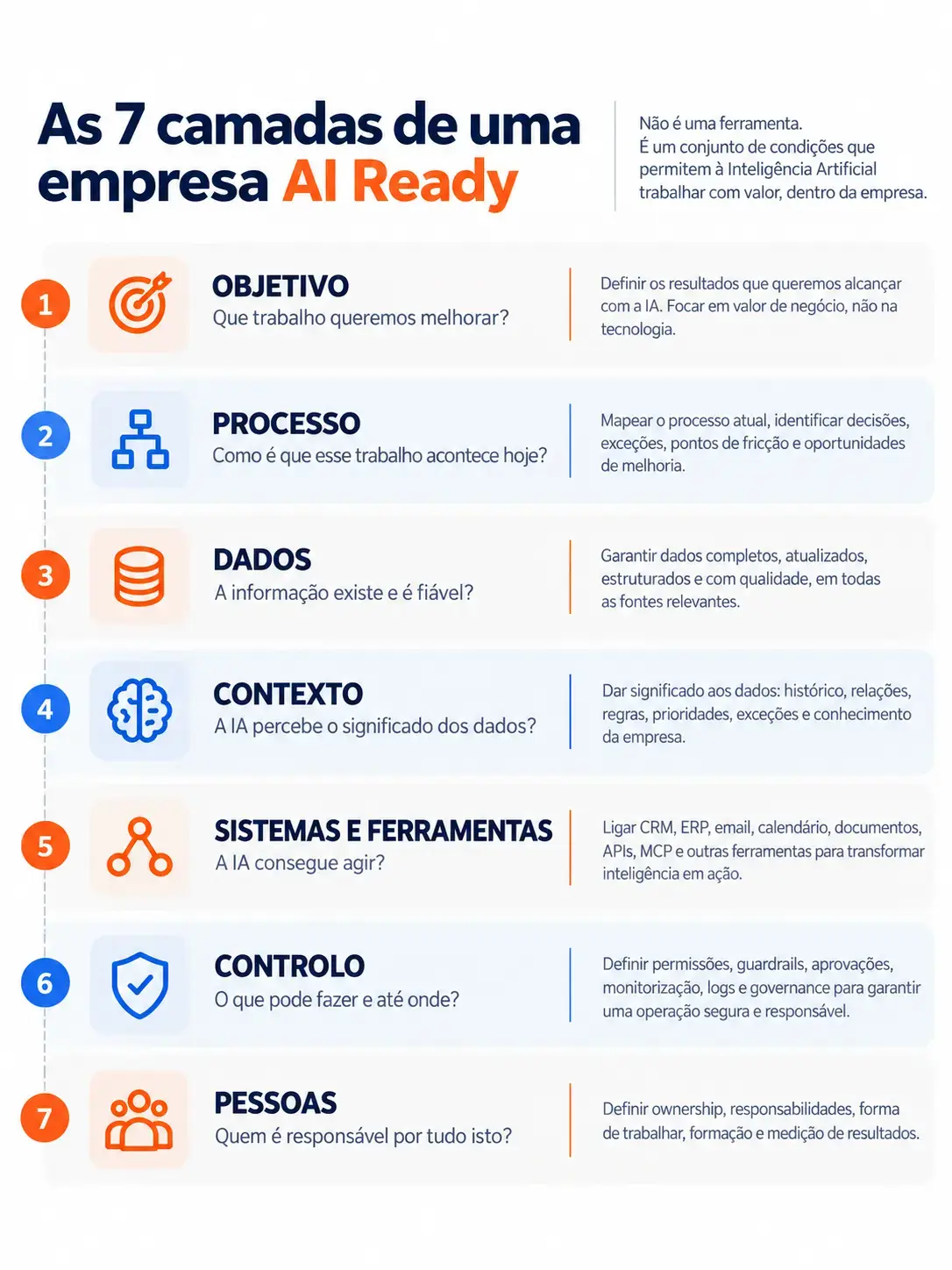
1. Objective: What work do we want to improve?
The worst way to start an AI transformation is to ask: “Where can we fit AI in?”
This means starting with the technology instead of starting with the problem.
I prefer a different question: What outcome do we want to improve?
More opportunities?
Less administrative work?
Faster responses?
Better support?
Better content quality?
Fewer errors?
Greater commercial capacity?
Better forecasting?
The agent comes later.
First, we need to know where we want to go.
2. Process: How does this work happen today?
Then we need to understand the process.
Who does it?
When?
What information is used?
What decisions are made?
What exceptions are there?
Where does it wait?
Where do you make mistakes?
Where is there repetitive work?
This part is crucial because many companies try to automate processes that, in reality, aren’t even well defined.
If we can’t explain to a person how the process works, we’re probably not ready to hand it over to an agent either.
3. Data: Does AI have reliable raw data to work with?
Next comes the data.
Where is it?
Who is responsible for it?
Is it complete?
Is it up to date?
Duplicated?
Are they structured?
Can we link them together?
An agent working with incorrect data doesn’t become smarter.
They just become faster at making the wrong decisions.
4. Context: Does AI understand the meaning of the data?
This is the layer I find most interesting, because context is more than just information.
It’s about understanding:
the customer;
the relationship;
the history;
the priorities;
the exceptions;
the objective;
the rules;
the company’s language;
and what has happened before.
That’s what transforms:
“50,000 €”
into:
“This is a strategic opportunity worth 50,000 €, requiring a decision by the CEO, where implementation is more important than price.”
The difference is enormous.
5. Systems and tools: Can AI take action?
Then there’s what turns intelligence into action.
CRM.
ERP.
Email.
Calendar.
Documents.
APIs.
MCP.
Data warehouses.
Internal applications.
Other agents.
This is where we move beyond a co-pilot that offers suggestions and into a system that can truly participate in the process.
6. Control: What can it do, and to what extent?
Next come the framework and governance.
Instructions.
Permissions.
Guardrails.
Approvals.
Logs.
Observability.
Assessment.
Rollback.
Human-in-the-loop.
The question here is simple: how much do we trust this system?
And the interesting part is that the answer doesn’t have to be the same for every task.
A company can give an agent complete autonomy to classify contacts and, at the same time, require human approval to send a sales proposal.
That’s perfectly normal.
7. People: Who is responsible for all of this?
And finally, we've reached the layer that will probably be the most difficult.
People:
- Who owns the agent?
- Who measures the results?
- Who changes the instructions?
- Who decides to increase autonomy?
- Who identifies errors?
- Who updates the processes?
- Who ensures that the data remains accurate?
- Who shuts it down if it stops making sense?
No serious business system can function without human ownership.
AI doesn’t change that.
"AI Ready" is not a state. It is a capability.
It’s also important to say this.
I don’t believe there will ever be a day when someone says, “All right. We’re done. Now we’re AI Ready.”
Models change. Tools change. Processes change. The business changes. Legislation changes, too. Even the capabilities of agents change.
Therefore, AI readiness is an ongoing capability.
It is the ability to progressively incorporate AI into the organization without having to start from scratch every time a new model emerges.
This is perhaps one of the biggest differences between experimenting with AI and building a competitive advantage with AI.
An experiment depends on the technology available at that moment.
An AI-ready organization is able to adopt new technologies as they emerge.
This is where transformation comes in—not just technology
That’s also why I’m becoming less and less interested in a vision of AI that focuses solely on tools.
I’m not particularly interested in implementing an agent just because it’s new, or even in automating everything we’re technically capable of automating.
What interests me is something else: where can AI dramatically increase people’s capabilities without us losing control, quality, or ownership?
That question inevitably leads to:
- processes;
- CRM;
- data;
- integrations;
- standards;
- governance;
- responsibilities;
- and work methods.
In other words:
business transformation.
Not simply technological implementation.
This is where our idea of AI Ready Transformation was born
At SmartLinks, we started calling this “AI Ready Transformation.”
Not because we think we’ve come up with a magic name, and certainly not because we want to invent yet another category.
Simply because we needed a way to describe a problem we were starting to see over and over again.
Companies want agents.
They want automation.
They want AI.
But often, what stands in the way of value comes before that.
It’s the process. It’s the CRM. It’s the data. It’s the integration. The context. It’s the definition of responsibilities. It’s the oversight.
Therefore, the approach we’re developing doesn’t necessarily start with:
“What kind of agent are we going to create?”
Start by:
“What does this company need to be able to do?”
And then:
- understand processes and objectives;
- identify the necessary data and context;
- organize CRM and systems;
- connect what needs to be connected;
- define rules and levels of autonomy;
- introduce agents or automations where they add value;
- measure what actually happened.
It’s not as flashy as showing an agent in a demo, but we believe it’s much more important.
That’s also why processes and standards are once again strategic
There’s a bit of irony here!
The more advanced Artificial Intelligence becomes, the more important some of the most basic aspects of a company become.
- Clear processes.
- Clean data.
- Ownership.
- Standards.
- Documentation.
- CRM.
For years, this seemed like red tape to many people. Now it’s starting to become AI infrastructure.
Because a clear, well-defined process can be taught to an agent.
A clear rule can serve as a guardrail.
A properly structured CRM can provide context.
A recorded meeting can become a memory.
An explicit definition of ownership can determine when an agent should escalate an issue to someone else.
This significantly changes the way we should view operations.
And the market is already moving toward this idea
Not everyone calls it the same thing.
OpenAI talks about Business Context, Agent Execution, evaluation, and governance. OpenAI
Microsoft talks about Agent Harnesses, workflows, tools, memory, context providers, and approvals. Microsoft Learn
Google discusses Agent Harnesses that connect models to tools, memory, and external systems. Google Cloud
HubSpot is bringing together CRM, Growth Context, Agent Hub, Agent Builder, Data Agent, and data integrations into an increasingly agent-centric platform. HubSpot
Deloitte is warning that the use of agents is advancing faster than governance. Deloitte
And KPMG shows that CEOs are investing, but there’s still a huge gap between one-off impact and real transformation. KPMG
The names are also still settling in.
- Agentic Enterprise.
- AI Operating Model.
- AI Transformation.
- Business Context.
- Agent Harness.
- AI Ready.
But this is the direction we’re heading in.
The next competitive advantage may lie in the company’s approach to the model
We’ll continue to have better models. Much better ones.
Faster and cheaper. Even more autonomous.
And we’ll keep discussing benchmarks.
Good.
But I'm starting to think that, for most companies, the key question will no longer be:
“Which model should we use?”
And it becomes:
“Is our company prepared for these models to operate within it?”
Because we all already have access to extraordinary intelligence.
So does our competitor. So does our customer.
And so does our supplier.
The difference will increasingly lie in what we are able to build around that intelligence.
Context.
Data.
Processes.
Tools.
Integrations.
Control.
Governance.
People.
The model still matters. Just as the horse still matters.
But the advantage lies in knowing where we want to go and building everything that will get us there.
For us, that’s what it means to be AI Ready.
Frequently Asked Questions About AI Ready and AI Agents
What does “AI Ready” mean?
An AI Ready company has processes, data, context, systems, governance, and teams in place to integrate Artificial Intelligence into its work in a secure, useful, and measurable way. It’s not just about acquiring AI tools.
What is the difference between an LLM and an AI Agent?
An LLM generates responses based on input. An agent adds capabilities such as tool usage, memory, task execution, and interaction with external systems, and can work through multiple steps to achieve a goal.
What is an Agent Harness?
An Agent Harness is the runtime infrastructure that wraps a model and manages elements such as context, memory, tool calls, state, approvals, loops, and observability, transforming the model into a system capable of performing work. Microsoft Learn
Why is CRM important for AI agents?
CRM contains essential context about customers: contacts, companies, deals, activities, meetings, emails, tickets, and history. When connected to AI, it can serve as one of the primary sources of context that enables agents to understand who the customer is and what has happened previously.
Does having ChatGPT or Copilot mean a company is AI-ready?
No. These tools can greatly increase individual productivity, but AI readiness also involves reliable data, clear processes, integrations, context, governance, permissions, and responsibilities.
What is “human-in-the-loop”?
“Human-in-the-loop” means designing systems in which people remain involved at points where human judgment, approval, or supervision is required. This does not mean approving every action; different tasks may have different levels of autonomy.
What should a company do first to become AI-ready?
The first step should not be to choose a tool or agent. It should be to identify which outcomes you want to improve, understand current processes, assess the available data and context, and only then decide where AI can create value.