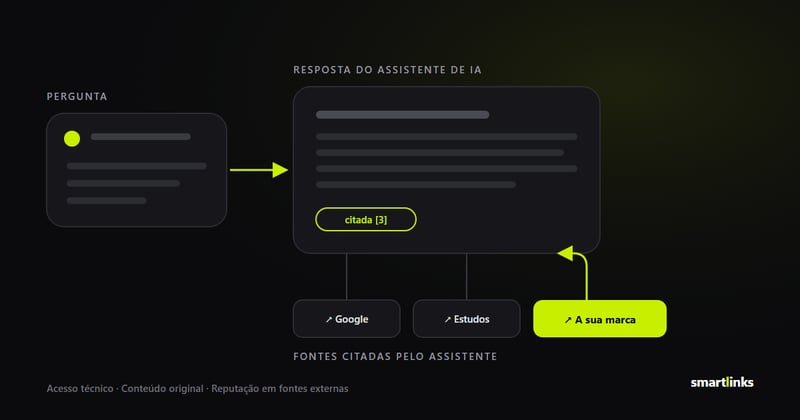
AI research highlights the pages that demonstrate the highest quality, the strongest presence and the greatest clarity. This guide brings together what official sources and verified studies have to say. It then translates all of this into priorities.
The essentials in six points
- The fundamentals of SEO continue to determine visibility in Google’s AI features.
- For other search assistants, the set of pages cited differs from Google’s top 10: only 12 per cent overlap (Ahrefs).
- Statistics, citations and sources within the text increased visibility by up to 40% in academic tests (Princeton).
- Adding schema to pages already cited maintained the number of citations (Ahrefs).
- Search crawlers (OAI-SearchBot, Claude-SearchBot, PerplexityBot) are the gateway. It is advisable to keep them authorised.
- A fixed set of prompts in Portuguese, measured every month, shows the actual progress.
How does AI-powered search choose its sources?
There are two main approaches. Each has its own rules.
Google: AI Overviews and AI Mode
Google explains that these features use retrieval-augmented generation (RAG) and query fan-out to highlight content from the search index (Semrush). The index is the same as for traditional search. Being in the index is the prerequisite for appearing in AI responses.
ChatGPT, Claude and Perplexity
These assistants use their own crawlers and indexes. The OAI-SearchBot builds the index for ChatGPT’s search (GEOToolbox). The Claude-SearchBot indexes pages for Claude’s search (The Rank Masters). The PerplexityBot performs the same function on Perplexity.
What the two approaches have in common
Three conditions recur across all the sources consulted:
- Access: the page must be accessible to the relevant crawlers.
- Value: the content must add something that other pages do not yet cover.
- Reputation: other reliable sources confirm the brand or author.
SEO, AEO and GEO: what changes and what remains the same
These three concepts form part of the same digital visibility strategy. Each has its own focus and addresses different ways of searching for and discovering information.
| Layer | Objective | Measure of success |
|---|---|---|
| SEO | Position in search results | Rankings, impressions, clicks |
| AEO | Direct answers in snippets and AI Overviews | Presence in direct answers |
| GEO | Mentions and recommendations in AI responses | Mentions, citations, recommendations |
Source: WRITER
Google argues that optimisation for generative search experiences should be based on the same principles that guide traditional SEO. From this perspective, improving visibility in AI-generated results remains part of SEO work, as these experiences rely on the ranking and quality systems of conventional search (Google Search Central).
Nevertheless, the industry uses different terms to describe this development. AEO (Answer Engine Optimisation) focuses on optimising content for answer engines. GEO (Generative Engine Optimisation) seeks to improve brands’ visibility and presence in AI-generated answers. It is also common to come across the term ‘AI SEO’, which frames these practices as an evolution of traditional SEO.
What Google recommends
On 15 May 2026, Google published the first official guide to optimising websites for AI-powered search features (Google Search Central). The key message is that good SEO practices remain the foundation.
Priorities of the guide
- Indexing and snippets: the page must be indexed and eligible to display a snippet.
- Search Console: the website must be included in AI-powered search features, a setting available in Search Console.
- Crawling: content must be publicly accessible and crawlable, with JavaScript adhering to Google’s best practices (Search Engine Land).
- Unique content: Google values useful and original content, which it describes as ‘hard to replace’.
- Images and videos: AI-generated answers may include images and videos, which opens up more entry points.
- Local and e-commerce data: the guide devotes a section to local businesses and e-commerce.
- AI agents: it includes initial guidance on this topic, which is still evolving.
A useful test for every page
Could an AI model write an equally useful version of this page? If the answer is yes, then something is missing that only the company has: its own data, project experience and informed opinion.
Practices the guide considers unnecessary
- llms.txt files and other machine-readable files created for AI.
- Markdown versions of the pages.
- Rewriting the text in a specific way for AI.
- A specific schema for AI features.
Source: Semrush and DemandSphere.
Scope and external references
This guide applies to Google Search (AI Overviews and AI Mode). For ChatGPT, Claude and other assistants, the findings serve as best practice, and the studies in the following section round out the picture (Practical Ecommerce).
Google notes that AI responses may reflect what is said about products and services on blogs, videos and forums (TechWyse). Genuine mentions help. Fabricated mentions risk being treated as spam.
What the studies reveal about citations
Two studies by Ahrefs help to distinguish between what works and what merely appears to work.
Rankings and citations are different
Ahrefs analysed 15,000 prompts across four AI assistants. On average, only 12 per cent of the links cited by ChatGPT, Gemini and Copilot appear in Google’s top 10 results for the same prompt. Perplexity is the AI assistant most closely aligned with SEO results. In AI Overviews, previous studies by the same company indicate that 76% of citations come from pages in the top 10 (Ahrefs).
The practical takeaway: a good ranking on Google helps in AI Overviews and Perplexity. ChatGPT and Gemini draw on other sources, which is why presence outside the website itself carries more weight.
Schema: useful for other purposes, neutral regarding citations
In May 2026, Ahrefs published a controlled study on JSON-LD. It tracked 1,885 pages that added schema between August 2025 and March 2026 and compared them with 4,000 control pages. The analysis covered Google AI Overviews, AI Mode and ChatGPT, over a 30-day period before and after the change (Ahrefs).
The result: no significant increase in citations on any platform. Prior to the study, an analysis of 6 million URLs had shown that pages cited by AI have around three times as much JSON-LD. The controlled experiment shows that this link is a correlation and that schema alone has little effect on the outcome (Search Engine Journal).
There are two limitations to note:
- All pages in the study already had more than 100 citations in the AI Overviews. The effect on pages that have not yet been cited remains unclear.
- The schema types were analysed collectively, so individual types may behave differently.
The recommendation: maintain the correct schema for the sake of rich results and technical clarity. Invest the extra time in content and external presence.
Presence outside the website itself
AI assistants form an opinion about a brand based on various sources. Google confirms that responses may reflect what is said on blogs, videos and forums. The Ahrefs study, which found only a 12 per cent correlation between mentions and top 10 rankings, points in the same direction: responses draw on a wide range of pages.
Where to build a presence
- Business and sector-specific press: opinion pieces and comments from company experts.
- Industry associations and events: speakers’ profiles, summaries of presentations, joint studies.
- Review platforms and directories: comprehensive profiles and genuine customer reviews.
- Video: interviews, demonstrations and short explanations, with descriptions and transcripts.
- LinkedIn and professional communities: regular sharing of company data and positions.
- Client case studies: results with figures, published with permission.
A principle that protects your investment
Genuine mentions build reputation. Google warns that fabricated mentions may be treated as spam. The safest approach is to give third parties good reasons to talk about the brand: original data, real-life case studies and useful opinions.
Content worth quoting
The academic study that coined the term GEO, presented at the KDD 2024 conference, showed that certain changes to content increase visibility in generative responses by up to 40 per cent (Princeton). The changes tested involved adding statistics, source citations and quotes from experts (arXiv).
The result comes from a controlled test environment and varies depending on the topic. It serves as a guideline and confirms what Google’s guidelines call for: useful, original and well-organised content.
Seven principles of citable content
- Answer right at the start. The first section summarises the answer in two or three sentences.
- Use your own data. Project results, industry averages, survey results – always with the date and source.
- Identify the author. Name, role and experience should be visible on the page.
- Cite original sources. Every key figure should include a link to the publisher.
- Organise with clear headings. Use H2 and H3 headings to describe the content of each section.
- Show the date of the last update. Review priority pages every quarter.
- Add Portuguese context. Examples, prices, regulations and cases from the domestic market.
Where is the competitive advantage?
The studies consulted for this guide use international data, and Portuguese-language prompts are awaiting the first major study. A company that publishes verified data on the Portuguese market is filling a gap in the market.
Technical access: crawlers and robots.txt
A page can only be cited if the relevant crawler can read it. Each AI company uses separate crawlers for three functions: search, model training and direct user requests (The Rank Masters).
| Platform | Search crawler | Function |
|---|---|---|
| Googlebot | Index that powers AI Overviews and AI Mode | |
| OpenAI | OAI-SearchBot | ChatGPT search index |
| Anthropic | Claude-SearchBot | Indexing for Claude search |
| Perplexity | PerplexityBot | Indexing for Perplexity search |
Sources: Cloudflare and GEOToolbox.
OpenAI states that websites which block the OAI-SearchBot are excluded from ChatGPT’s search results. A change to the robots.txt file takes around 24 hours to take effect for this crawler.
How to decide
- Search crawlers (OAI-SearchBot, Claude-SearchBot, PerplexityBot): keep authorised. They are the gateway to citations.
- Training crawlers (GPTBot, ClaudeBot): this is a business decision, independent of search visibility.
- User requests (ChatGPT-User, Claude-User): these are from people asking the assistant to read a specific page.
Four-step check
- Review the robots.txt file and confirm the rules for each crawler.
- Check firewall, CDN and anti-bot protection rules, which sometimes block legitimate crawlers.
- Confirm in Search Console that priority pages are indexed and eligible for snippets.
- Ensure that essential content appears in the loaded HTML, following Google’s JavaScript best practices.
Crawler rules change frequently. It is always advisable to check the official websites of each company before making any changes to the robots.txt file.
How to measure visibility in AI
Assistant responses vary from day to day. A fixed method, repeated every month, turns this variation into a trend. The method below is a working recommendation.
Step 1: Define the prompts in the target market’s language
Decide how many prompts you wish to track. For example:
- 10 problem-based prompts: how the client company describes the challenge (“how to improve the business process of a manufacturing company”).
- 10 comparison prompts: how they search for solutions and suppliers (“best CRM consultancies in Portugal”).
- 10 decision prompts: how they validate a choice (“is it worth migrating the CRM to HubSpot?”).
Step 2: Run the prompts through the main AI assistants
ChatGPT, Gemini, Claude, Perplexity and Google (AI Overviews and AI Mode). Repeat each prompt three times and record the results in a spreadsheet.
Step 3: track five indicators
| Metric | What it shows | How to calculate |
|---|---|---|
| Mention rate | Frequency with which the brand appears in the response | Responses containing the brand ÷ total number of responses |
| Citation rate | Frequency with which the domain appears as a source | Responses containing a link to the domain ÷ total |
| Share of voice | Brand weight relative to the competition | Brand mentions ÷ mentions of all brands |
| Pages cited | What content works | List of the most cited URLs |
| Referral traffic | Visits from assistants | Sessions by source in web analytics |
HubSpot’s AEO module automates part of this monitoring: brand visibility, mentions, citations and share of voice compared to competitors, with details by assistant.

How to interpret the results
Figures for a single month on their own are not very informative. Comparing months shows the trend. An increase in mentions in comparison prompts is the first sign that your external presence efforts are paying off.
How many times has your brand been mentioned today?
We measure your visibility across the leading AI assistants and link it to your CRM, right through to qualified sales meetings.

From mention to qualified meeting
For a B2B company, visibility is worth what it generates: leads, conversations and sales meetings. Linking these four stages allows you to understand the real return on investment.
- Visibility: mentions and citations in AI assistants (previous section).
- Visits: sessions originating from ChatGPT, Gemini, Claude, Perplexity and Google, identified by traffic source.
- Contacts: leads with the source recorded in the CRM.
- Meetings: qualified sales meetings held – the metric that closes the loop.
How to record the source in the CRM
- Create the option “AI search” in the lead’s source field.
- Add the open-ended question “How did you find us?” to the contact form. Anyone who discovers the company via an AI assistant may have arrived via a brand search or direct access, so the contact’s own response completes the traffic data.
- Review the responses monthly and create categories as patterns emerge.
A simple monthly report
A monthly report can bring together four metrics to track the evolution of AI visibility and its impact on the business: mention rate, referral sessions from AI assistants, leads originating from these channels, and qualified meetings.
Analysing these indicators together helps to understand whether increased visibility translates into traffic, commercial opportunities and results. Progress should be analysed over time and in conjunction with other factors that influence customer acquisition.
90-day plan
A 90-day plan organises the work into three phases: diagnosis, implementation and evaluation. Over this period, it is possible to test hypotheses, introduce improvements and monitor the first signs of progress.
The duration of each task and the number of pages, prompts or actions should be tailored to the size of the website, the resources available and the business objectives.
Days 1 to 30: foundations and starting point
- Check indexing, eligibility for rich results and the status of Google Search Console.
- Review the robots.txt file, the firewall and the CDN to ensure that search crawlers can access the content.
- Define a set of prompts relevant to the business and measure initial visibility across the main AI assistants.
- Identify the pages with the greatest potential for traffic, visibility and conversion.
Days 31 to 60: content and presence
- Review and optimise priority pages: present clear answers at the start, add your own data, identify authors, cite sources and update the information.
- Create original content, such as studies, analyses or datasets relevant to the sector.
- Strengthen external presence with actions tailored to the business: articles in specialist publications, participation in events, listings in relevant directories and video content.
Days 61 to 90: measurement and adjustment
- Repeat the analysis of the prompts and compare the results with the baseline.
- Link visibility and traffic data to the CRM to track the source of leads and sales opportunities.
- Evaluate the changes implemented and identify those yielding the best results.
- Define the next priorities and schedule a further review.
Please note: 90 days may be sufficient to implement changes and identify initial signs of progress, but they do not guarantee SEO or GEO results. Not all actions have an immediate effect, so monitoring should continue over the following months.
Conclusion: preparing today for tomorrow’s visibility
Visibility in AI-powered search is built on three ingredients: technical access, original content and reputation on external sources. Google confirms that the fundamentals of SEO play their part. Studies by Ahrefs show that other assistants benefit from a broader presence. Monthly measurement links everything to the business objective.
Those who start now have a clear advantage. Data on the Portuguese market is still scarce, and every company that publishes verified information gains ground.
Turn this guide into a plan for your business
We’ll assess your AI visibility, set priorities for the first 90 days and link the results to qualified sales meetings.

Sources
- Google Search Central, ‘Optimising your website for generative AI features on Google Search’ (May 2026).
- Google Search Central Blog, A new resource for optimising for generative AI in Google Search (15 May 2026).
- Ahrefs, Only 12% of AI-cited URLs rank in Google’s top 10.
- Ahrefs, Schema and AI citations (May 2026).
- Search Engine Journal, ‘Schema Markup Didn’t Move AI Citations In Ahrefs Test’ (May 2026).
- Aggarwal et al., GEO: Generative Engine Optimisation, KDD 2024 (Princeton).
- Semrush, Google publishes guide to optimising for generative AI search (2026).
- Search Engine Land, ‘Google publishes guide on optimising for generative AI features’ (2026).
- DemandSphere, Google’s AI optimisation guide (2026).
- Link-Assistant, Google’s AI search guide (2026).
- Practical Ecommerce, Google Says AI Optimisation Is Just SEO (2026).
- TechWyse, Google’s AI search guide (2026).
- WRITER, GEO, AEO and SEO in 2026 (2026).
- Wikipedia, Generative engine optimisation.
- Cloudflare, Bot reference.
- GEOToolbox, AI crawlers (2026).
- The Rank Masters, AI crawlers in robots.txt (2026).
How this article was produced
We wrote this article with the support of artificial intelligence and it underwent human review: one expert reviewed the text (copy) and another validated the content from a technical perspective. The sources are cited throughout the article and in the list above. Editorial responsibility lies with SmartLinks.