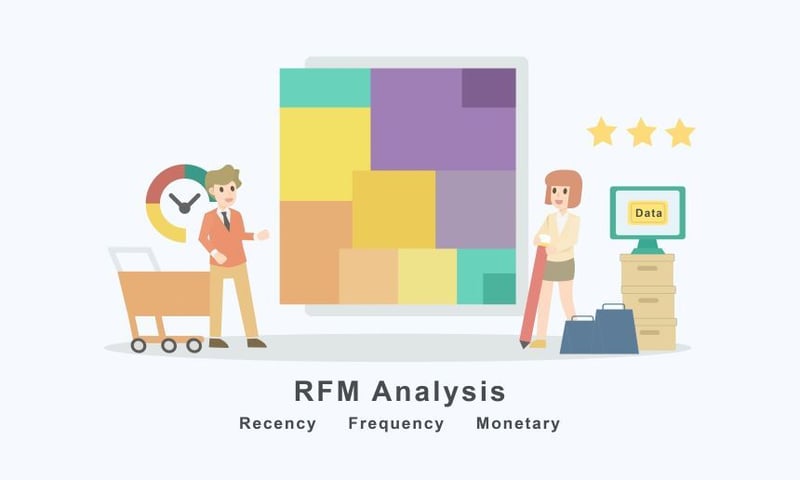
Most sales teams treat their contact base as if every customer were worth the same. They are not. The Pareto principle still applies: a minority of accounts generates most of the revenue, and the problem is that many companies do not know which ones.
RFM (Recency, Frequency, Monetary) analysis is a simple model to solve that using data you already have in your CRM.
What RFM is
RFM classifies each account or contact across three dimensions of real behaviour, not demographics:
- Recency: how long since the last purchase, renewal or relevant interaction?
- Frequency: how regularly does it buy, renew or expand?
- Monetary: how much has it generated in revenue over the relationship?
Each dimension gets a score (typically 1 to 5), and the combination defines the account's strategic value. More useful than segmenting by industry or size, RFM segments by how the customer actually behaves.
Why it works in B2B (not just e-commerce)
The model started in email marketing and became popular in e-commerce, but the logic transfers straight to B2B, where value per account is much higher and retention and expansion matter more than acquisition:
- Recency reveals accounts at risk of churn before the contract ends.
- Frequency separates recurring buyers from one off ones.
- Monetary shows where revenue is concentrated, and where there is room for upsell and cross-sell.
Instead of retail micro-segments, in B2B you only need four actionable groups:
| Segment |
Profile (RFM) |
Action |
| Key accounts |
Recent, frequent, high value |
Retain, expand, turn into references |
| To develop |
Good value, low frequency |
Cross/upsell, increase recurrence |
| At risk |
High historical value, no recent activity |
Reactivate before churn |
| Low priority |
Low scores across all three |
Automate, do not spend sales time |
The benefits
- Sales focus: the team invests time where revenue is, not on the account that shouts loudest.
- Actionable reporting: the pipeline stops being a list and gains a hierarchy of value.
- Retention: you spot at risk accounts while there is still time to act.
- Expansion: you see where upsell is most likely, instead of guessing.
How SmartLinks applies RFM in your CRM
RFM is only useful if it is instrumented in the system, not in a spreadsheet nobody updates. In our CRM & RevOps work, we calculate the RFM score from HubSpot data: the score lives as an account property, feeds Revenue Intelligence and triggers automations (reactivating "at risk" accounts, expansion alerts on key accounts).
That way prioritisation stops being opinion and becomes a layer of the system.
You probably already have everything in HubSpot to know which your key accounts are. The question is whether that data is working for you or just piling up. Find out in the Diagnosis.
References
- Investopedia, RFM (Recency, Frequency, Monetary Value)